
QUESTION
My Elan +2 has rear drive-shafts with a rotoflex at one end and a CV joint at the other.
I am fitting the rotoflex couplings that Lotus Marqes recently supplied to me.
I need confirmation of the correct way to fit the failsafe coupling/tube parts.
Is it on the differential side or the shaft side?
P.M. - Warriewood, NSW
ANSWER
If you are looking to modify your rear drive-shaft components so the Rotoflex couplings are fail-safe, then its wise to follow the original Lotus scheme.
To make the Rotoflex couplings fail-safe, Lotus modified the the intermediate shaft, differential shaft and outboard drive-shaft (on both of the later Elan and Elan +2).
The intermediate shaft was modified by welding on short tubes in the centre at both ends of the shaft.
The differential shaft and outboard drive-shaft were both modified by welding 10mm diameter pegs into the centre of the three fingered drive flange.
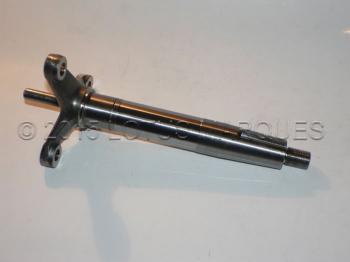 Lotus Elan rear driveshaft complete with fail-safe pin
On final assembly the pins are located inside the tubes to prevent the mating shafts from moving apart in the event of a Rotoflex coupling failure.
Whilst this simple modification is an excellent idea, this does make changing Rotoflex couplings more difficult.
If you wish to carry out this modification and improve on the original concept, then the addition of a centring plate with an integral spherical bearing is a useful addition.
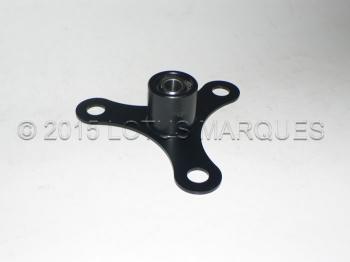 Fail-safe centring plate for Rotoflex couplings
Instead of welding a tube on to the intermediate shaft, a centring plate can be simply sandwiched between the three finger drive flange and Rotoflex coupling.
The spherical bearing locates on the peg of the mating shaft to eliminate any eccentric orbiting motion and also provides fail-safe functionality.
For more information about the centring plates, please see the product data sheet here.
These centring plates are currently in stock at $95.00 each plus GST.
Please note carefully - Pricing is correct at date of publication but may change over time.
Copyright © 2015 Lotus Marques
My Elan +2 has rear drive-shafts with a rotoflex at one end and a CV joint at the other.
I am fitting the rotoflex couplings that Lotus Marqes recently supplied to me.
I need confirmation of the correct way to fit the failsafe coupling/tube parts.
Is it on the differential side or the shaft side?
P.M. - Warriewood, NSW
ANSWER
If you are looking to modify your rear drive-shaft components so the Rotoflex couplings are fail-safe, then its wise to follow the original Lotus scheme.
To make the Rotoflex couplings fail-safe, Lotus modified the the intermediate shaft, differential shaft and outboard drive-shaft (on both of the later Elan and Elan +2).
The intermediate shaft was modified by welding on short tubes in the centre at both ends of the shaft.
The differential shaft and outboard drive-shaft were both modified by welding 10mm diameter pegs into the centre of the three fingered drive flange.
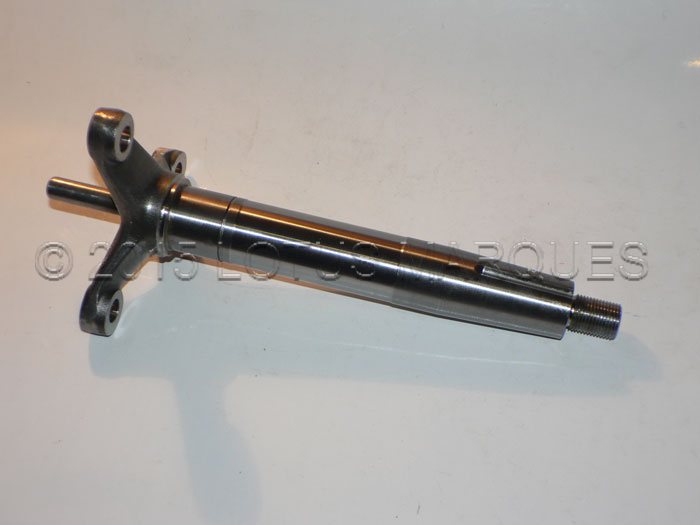 Lotus Elan rear driveshaft complete with fail-safe pin
On final assembly the pins are located inside the tubes to prevent the mating shafts from moving apart in the event of a Rotoflex coupling failure.
Whilst this simple modification is an excellent idea, this does make changing Rotoflex couplings more difficult.
If you wish to carry out this modification and improve on the original concept, then the addition of a centring plate with an integral spherical bearing is a useful addition.
 Fail-safe centring plate for Rotoflex couplings
Instead of welding a tube on to the intermediate shaft, a centring plate can be simply sandwiched between the three finger drive flange and Rotoflex coupling.
The spherical bearing locates on the peg of the mating shaft to eliminate any eccentric orbiting motion and also provides fail-safe functionality.
For more information about the centring plates, please see the product data sheet here.
These centring plates are currently in stock at $95.00 each plus GST.
Please note carefully - Pricing is correct at date of publication but may change over time.
Copyright © 2015 Lotus Marques