
QUESTION
When I bought my Lotus Esprit turbo , I checked compression and the values were 120-125psi cold.
Couple month ago, I swapped to the green dot pulleys.
This was my first complex job of this kind.
I made a mistake installing cam sprockets facing "wrong" side forward.
I caused the mistake because I run a compression test.
It showed 55psi across all cylinders.
I corrected the problem, but did not check compression again.
Well, until now and this time readings came low, 85-95 psi across all cylinders.
I was puzzled and was wondering if it is possible that "something off" in the valve-train may cause low readings?
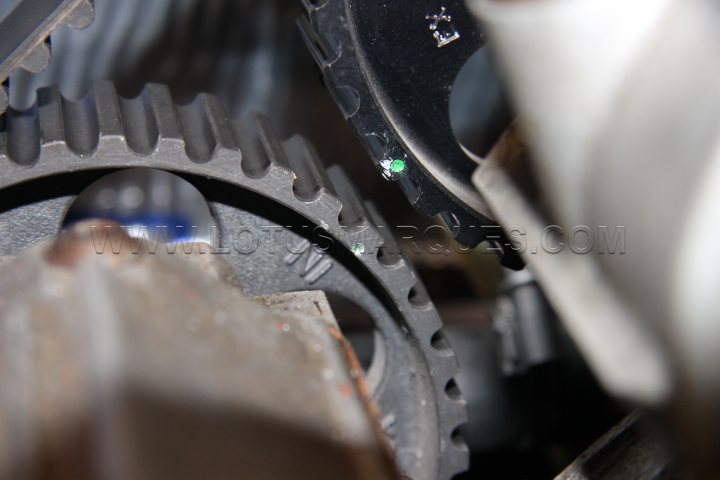
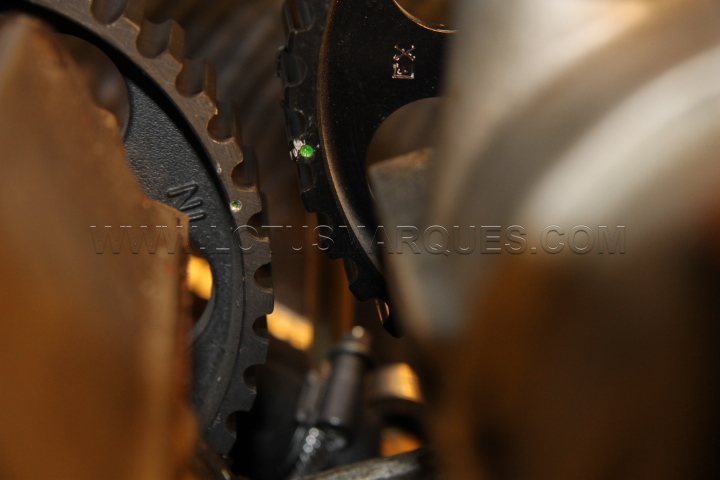
On the hunch, I set the crank pulley mark at "0" and shot couple of pictures.
I did it twice, to be sure.
See what I got!
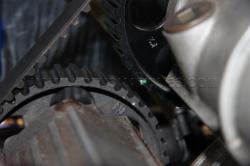

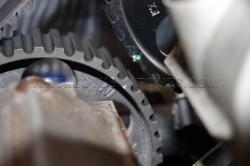

I think, intake cam is one tooth off.
Would it make such a great difference in the compression reading?
C.G. - USA
ANSWER
It is recommended before making any changes/adjustments that the engine be turned in a clockwise direction for two complete revolutions with a ratchet and socket on the front crankshaft pulley bolt.
Then with a Burroughs gauge check the timing belt tension (should read 95 units) at 20 degrees Centigrade.
At this point, turn the engine carefully until the crankshaft timing marks show TDC with No1 piston at the top of the bore (compression stroke) and re-check the cam pulley timing marks.
With the inlet camshaft retarded, this means that the following conditions will be present:
1) Low compression readings across all four cylinders
2) Poor combustion and high CO readings
3) Poor quality idle speed
4) Poor throttle response
5) Poor cold starting characteristics
6) Lack of power
Looking at the above photographs and assuming the crankshaft is at true TDC, then it appears the inlet camshaft is retarded
This will have a profound affect on the engine in a number of ways.
To better understand why camshaft timing is so sensitive, consider the engine as a pump drawing in air, then compressing it.
If either the inlet or exhaust camshaft are changed from the recommended settings then this will reduce pumping efficiency.
Optimal camshaft timing can be achieved by connecting a vacuum gauge to the inlet manifold and gradually adjusting the camshaft timing until the greatest vacuum reading is obtained.
This is best carried out by using vernier camshaft pulleys to make very small changes in cam timing.
With the inlet camshaft retarded the valves should not have made mechanical contact with the pistons.
It is critical the camshaft timing be set to the Lotus specifications so as to maximise horse-power and minimise emissions.
If you are looking for maximum power then use GREEN dot timing pulleys on both inlet and exhaust camshaft.
From experience it is possible to swap the auxiliary pulley to make up a matched pair of pulleys.
Copyright © 2012 Lotus Marques
When I bought my Lotus Esprit turbo , I checked compression and the values were 120-125psi cold.
Couple month ago, I swapped to the green dot pulleys.
This was my first complex job of this kind.
I made a mistake installing cam sprockets facing "wrong" side forward.
I caused the mistake because I run a compression test.
It showed 55psi across all cylinders.
I corrected the problem, but did not check compression again.
Well, until now and this time readings came low, 85-95 psi across all cylinders.
I was puzzled and was wondering if it is possible that "something off" in the valve-train may cause low readings?
On the hunch, I set the crank pulley mark at "0" and shot couple of pictures.
I did it twice, to be sure.
See what I got!
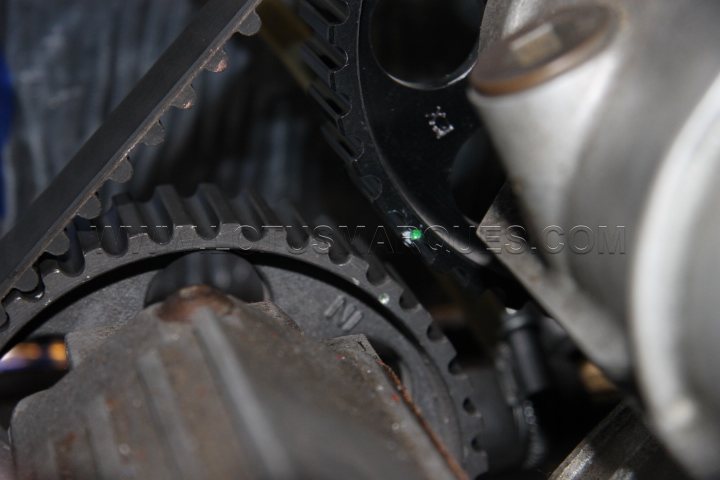
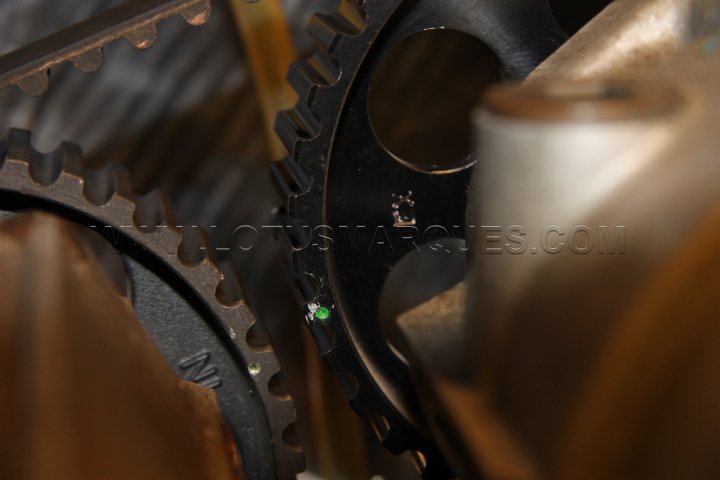
I think, intake cam is one tooth off.
Would it make such a great difference in the compression reading?
C.G. - USA
ANSWER
It is recommended before making any changes/adjustments that the engine be turned in a clockwise direction for two complete revolutions with a ratchet and socket on the front crankshaft pulley bolt.
Then with a Burroughs gauge check the timing belt tension (should read 95 units) at 20 degrees Centigrade.
At this point, turn the engine carefully until the crankshaft timing marks show TDC with No1 piston at the top of the bore (compression stroke) and re-check the cam pulley timing marks.
With the inlet camshaft retarded, this means that the following conditions will be present:
1) Low compression readings across all four cylinders
2) Poor combustion and high CO readings
3) Poor quality idle speed
4) Poor throttle response
5) Poor cold starting characteristics
6) Lack of power
Looking at the above photographs and assuming the crankshaft is at true TDC, then it appears the inlet camshaft is retarded
This will have a profound affect on the engine in a number of ways.
To better understand why camshaft timing is so sensitive, consider the engine as a pump drawing in air, then compressing it.
If either the inlet or exhaust camshaft are changed from the recommended settings then this will reduce pumping efficiency.
Optimal camshaft timing can be achieved by connecting a vacuum gauge to the inlet manifold and gradually adjusting the camshaft timing until the greatest vacuum reading is obtained.
This is best carried out by using vernier camshaft pulleys to make very small changes in cam timing.
With the inlet camshaft retarded the valves should not have made mechanical contact with the pistons.
It is critical the camshaft timing be set to the Lotus specifications so as to maximise horse-power and minimise emissions.
If you are looking for maximum power then use GREEN dot timing pulleys on both inlet and exhaust camshaft.
From experience it is possible to swap the auxiliary pulley to make up a matched pair of pulleys.
Copyright © 2012 Lotus Marques