
Since this specialist business has been recently sold off and the original owner has retired, it appears that much of the expertise and customer service left the business at the same time.
Lotus Marques has accumulated some 30 years plus experience with Lotus twin cam cylinder heads.
Nothing prepared us for a brand new head with so many problems which could only be described as not fit for purpose.
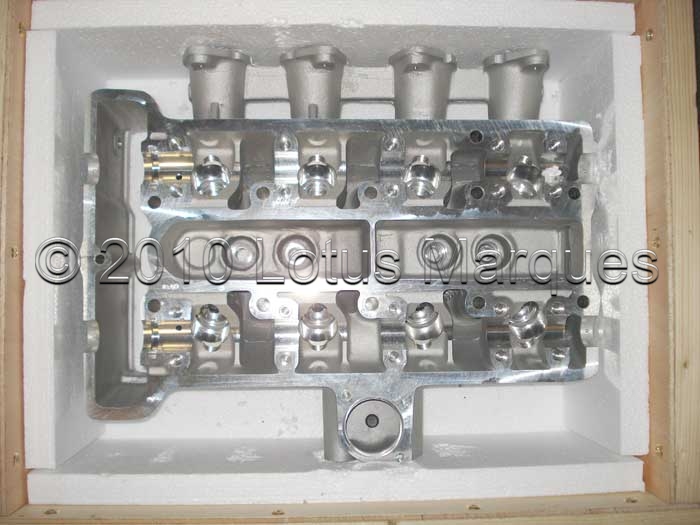
This brand new, freshly machined cylinder head was supplied as a "replacement standard head".
Now what could possibly go wrong? What gradually unfolded was that the head could never be assembled with standard springs and valves etc.
Problems discovered were as follows –
a) The flame face measured 0.017” different across all four corners. This was caused by the head flame face being machined with three tool passes instead of one. It was necessary to remove 0.020” off the flame face to get it flat.
When questioned about this problem, were told by the manufacturer/supplier the new head would be OK to put straight on to the block.
If this advice had been followed, the head gasket would never have sealed
b) The combustion chambers had been CNC milled to be a perfect hemisphere.
One problem, the apex of the chamber was too low from the top face of the head by approximately 0.070” Consequently the combustion chamber volume only measured about 37cc.
The entire combustion chamber roof had been moved significantly closer to the top of the pistons.
Anyone who is familiar with Lotus twin cam cylinder head will know the combustion chamber is in fact a pear shape and NOT a perfect hemisphere.
The standard pear shaped combustion chamber is the correct profile to accommodate different diameter valves.
This allows the valve seats to sit at the correct height and blend into the chamber ceiling without shrouding the valves and interfering with the gas-flow.
c) The change in the chamber position moved the valve seats and valves further forward.
d) The consequence of this was the standard valve springs were going to coil bind in the spring pockets which were already too shallow.
e) The standard length valve could not be fitted as it would further compound valve spring coil bind problems
f) The camshaft centre line to valve spring pocket had been machined too shallow compounding the valve spring coil binding problem.
g) The cam follower bores were not deep enough and as a result of this, the follower skirt hit the casting underneath as the camshaft rotated towards full lift. You could not rotate the cams fully as the follower skirts made mechanical contact.
h) To rectify this, it was necessary to CNC circular mill the area directly underneath the follower bores to relieve the casting.
i) Normally this would not be a problem in a standard Lotus head as the follower cast iron sleeve (and the bore in the parent metal) provides sufficient back clearance so the follower skirt does not hit the casting directly underneath.
j) In this new cylinder head, the cam followers run directly in the alloy head without the need of a cast iron follower sleeve.

When these problems were flagged to the supplier, Lotus Marques was told to recess the valves in the combustion chamber. If this advice had been followed, the valve seats would have been recessed so far they would be out the other side of the head.
The only standard components that could be installed in this head were the original camshafts and the spring retainers. All the other parts fitted were customised so as to make the head operate correctly and install shims within the normal range.
After numerous trial assemblies, measuring, machining and installing non-standard parts, a quality result was achieved.
About the author
Steve Taylor: is the business owner of Lotus Marques who has a multidiscipline background. This includes 12 years engineering experience gained whilst working on weapon systems design and development for UK Department of Defence. He has also worked for 7 years in a cutting-edge American super-computer company Gould CSD as the UK southern region support manager. During this time he developed a passion for Lotus Cars and motor racing at Brands Hatch Racing School. Emigrating from the UK to Australia in 1987, where in 1992 Lotus Marques commenced trading as a specialist parts supplier. The business offers log-book servicing and repairs as well as designing and manufacturing a range of high quality components to support Lotus owners world-wide.
Copyright © 2011 Lotus Marques