
The standard rear suspension on a Lotus Elan is fully independent and utilises a Chapman strut (derived from the McPherson strut) with internal shock absorber plus coil spring.
The Chapman strut is installed into an alloy housing that also incorporates the wheel bearings and outboard drive shaft. The bottom of the housing is secured to the chassis via lightweight tubular steel “A” frame.
The upper part of the shock absorber spindle is fastened to the chassis by a flexible rubber mounting, often referred to as a “Lotocone”.
Standard drive train components
The differential drive shaft is attached to the outboard drive shaft via an intermediate shaft that has rubber couplings fastened at either end.
The two rubber couplings sandwiched in each shaft, transmit the torque to the road wheels.
These couplings behave like a universal joint but also flex in the axial plane.
This flexing movement allows the drive shaft to effectively change length as it moves through full suspension travel.
The expected service life of rubber drive shaft couplings under normal driving conditions is 5 to 6 years.
Period servicing information and overhauls of the Lotus Elan differential indicates that the rubber couplings may reduce the shock load transmitted from the road wheel to the differential.
When the standard rubber couplings are retained, it is typical to see differentials being rebuilt between 120,000 and 150,000 miles.
However there are a number of other factors that influence this interval.
This includes the engine power output, owners driving habits and whether or not regular maintenance and oil changes have been carried out during the life of the differential.
Positive attributes:
• Low unsprung weight (combined weight of 2 x rubber couplings, intermediate shaft, fasteners = 3.9kgs)
• Torsion bar effect of rubber couplings influences the resultant spring rate at rear road wheel.
• Zero maintenance required.
Negative attributes:
• Take-off surge caused by the couplings winding up when the clutch is operated.
• Can cause significant damage if allowed to fail and therefore requires regular inspection.
• Can be difficult and time consuming to replace.
• Rubber couplings are a consumable item and have a high replacement cost.
Approved methods to improve standard drive train components
Always install the heavy-duty metal-interleaved rubber couplings manufactured by Dunlop.
These are of a superior construction and are x-rayed for hidden air bubbles.
These internal voids can form during the manufacturing process and may cause premature component failure.
Install spherical bearing and mounting plate to eliminate drive shaft orbital action. This component extends rubber-coupling life and makes the existing drive train fail-safe in the unlikely event of coupling failure.
Solid drive shaft utilising sliding spline and universal joints
Installing sliding spline and universal joint drive shafts in a standard road going Elan is not an effective investment due to inherent design limitations.
However it is understood that some Elan owners may have to install this system on their Lotus Elan race-car to comply with local historic race category regulations.
The limitations of this installation are:
• The standard Lotus Elan rear suspension allows a significant amount of suspension travel and universal joints are only designed to move through a few degrees of deflection.
Therefore when universal joints are extended beyond their design limits, the expected service life is significantly reduced.
• The sliding spline joint needs constant maintenance in terms of keeping it clean and ensuring the seal excludes the abrasive dust and dirt found on regular roads.
• The sliding spline joint needs regular inspection and lubrication to ensure it does not lock up.
This type installation was applicable at the time it was initially designed and installed in the Lotus Elan 26R. This was acceptable for the following reasons.
• Limited number of racetrack miles during any calendar year.
• Safety checks and constant maintenance on a race car
• The Lotus Elan 26R ride height was lowered with special suspension components front and rear.
• The Lotus Elan 26R suspension travel was reduced with special suspension components front and rear.
• Short duration and excessive suspension movement reduced by smooth race track surface
• Installing magnesium alloy parts reduced un-sprung weight of various components.
Components that influence suspension travel and resultant drive shaft angles
• Worn, damaged or soft rear top suspension mounting (Lotocone)
• Damaged top suspension towers that are prone to buckling on early chassis
• Manufacturing tolerances of the chassis
• Manufacturing tolerances of the rear lower suspension control arm
• Service condition of the rear lower suspension control arm
• Service condition of the rubber bushes in the rear lower suspension control arm
• Service condition of the rubber bushes that mount the differential to the chassis
• Manufacturing tolerances of the rear suspension housing and McPherson strut.
• Varying strut lengths and different thread detail offered by various shock absorber manufacturers.
• Service condition of rubber drive shaft couplings if installed.
The component that appears to have had the largest influence in changing rear suspension geometry is the Lotocone.
At some point in time either the supplier has been changed or the design of the Lotocone has been changed.
The early type Lotocone had an all-metal external casing with a rolled lip at the top.
The later type Lotocone has the same general dimensions but no metal external casing or rolled top lip.
More importantly the critical dimension from the base mounting plate to the top of the crush tube has been changed.
This change in dimension has effectively lowered the top strut fixing point and in turn allowed approximately 6.50mm of additional suspension droop.
Whilst this may not appear to be important, this change is quite significant to solid drive shaft components that are sensitive to small angular changes.
Lotocones
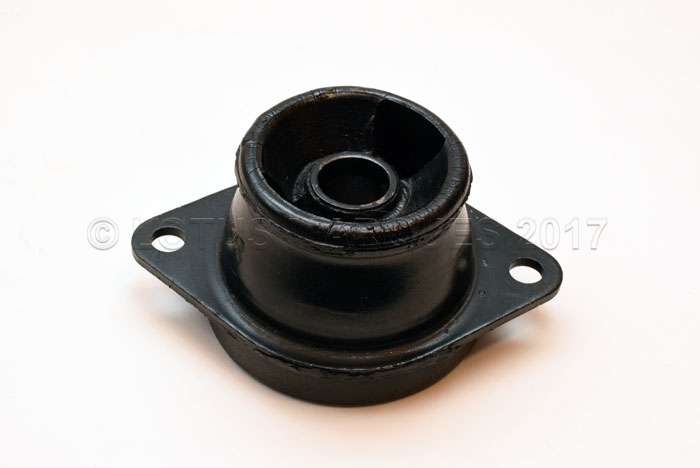
The photograph above shows an early type Lotocone.
Note the rolled lip at the top of the mount and also the relative position of the centre crush tube.
The early type Lotocone is obsolete and no longer available so it has been replaced by the later component below.
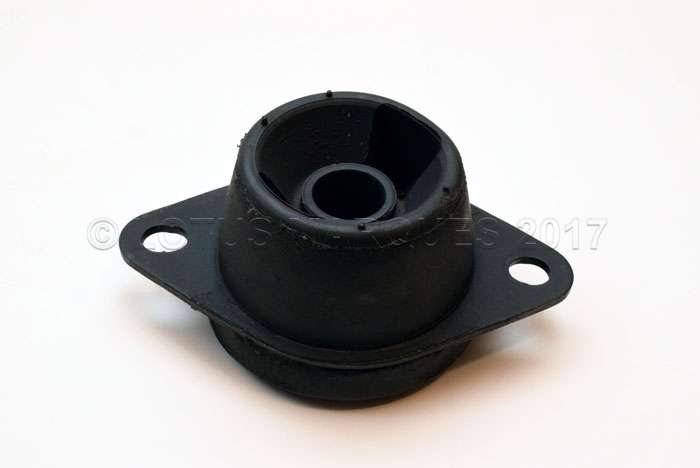
The photograph above shows a later type Lotocone.
Note the external detail at the top of the mount has no rolled lip and also the relative position of the centre crush tube. The top of the centre crush tube is much lower than the earlier type mount.
Approved methods to reduce rear suspension droop
• Install suitably modified shock absorber strut with limited travel.
• Install solid rear strut mounting with spherical joint that moves the fixing point upwards.
If you have installed a sliding spline or CV drive shaft kit, then you have also modified the suspension characteristics of your Lotus Elan.
By removing the original rubber drive shaft couplings and intermediate drive shaft you have just changed or influenced the shock absorber travel and body roll.
When the standard suspension moves towards the full droop position, the bending or distortion of the rubber coupling resists the downward movement of the wheel-bearing hub.
Conversely, when the suspension moves towards the full bump position, the bending or distortion of the rubber coupling resists the upward movement of the wheel-bearing hub.
This effect can be considered as an integral torsion bar that changes the effective spring rate at the road wheel.
When the wheel-bearing hub starts to move in either direction, then the two rubber couplings are opposing each other. This means there is a beneficial force that is applied across the intermediate drive shaft to counteract the hub moving in a given direction.
If you have installed a Lotus Elan CV drive shaft conversion, then it maybe useful to consider restoring the opposing force exerted by the rubber couplings at each rear suspension strut.
With the increase in engine power and changing from rubber couplings to universal joints plus sliding spline drive shafts, may partly explain the decision to install a rear anti-roll bar in the Lotus Elan 26R.
Design considerations for a CV conversion kit
Maximum power output of any given engine installation.
Correct choice of steel alloy for axle.
Correct heat treatment for axle.
Correctly machined axle including, various diameters, generous radii, precision cut splines and circlip grooves.
Allowance for change in axle length during suspension travel from full bump to full droop.
Carefully designed adapter plate to accommodate axle float (lateral movement) within CV joint.
Minimising unsprung weight by carefully lightening adapter plate.
Correct choice of safety fasteners, grade of bolts and nyloc nuts etc.
Full analysis of various shear planes through fasteners to determine safe shank lengths.
CV drive train components
A simple CV drive shaft kit will usually comprise of a new intermediate shaft with splines cut at each end. CV joints are then installed on the splines and secured by circlips.
The CV joints are then attached to an adapter plate via cap screws.
The adapter plate is then attached to the standard inboard and outboard drive shafts by 7/16 UNF captive fasteners and nyloc nuts.
There is now some evidence emerging to suggest that solid drive shaft installations increase the shock load transmitted from the road wheel to the differential.
This is deduced by the shorter differential overhaul period observed which is 80,000 to 120,000 miles.
However there are a number of other factors that influence this interval.
This includes the engine power output, owners driving habits and whether or not regular maintenance and oil changes have been carried out during the life of the differential.
Positive attributes:
Elimination of rubber drive shaft wind-up.
Easy installation.
Facilitates easy replacement of CV joints.
Extended component service life that is in excess of 100,000 miles.
Negative attributes:
High initial purchase cost when compared with replacing all four rubber couplings.
Increased un-sprung weight (combined weight of 2 x CVs, 2 x adapter plates, shaft and fasteners = 5.10Kgs)
Requires regular inspection of rubber boots.
Requires lubrication of all four CV joints.
Dispelling a popular myth
There is a popular myth that is circulated where it is suggested that a CV conversion is too rigid and provides no cushioning effect or shock-load reduction to the Elan differential internal components
The inference is, the removal of the rubber Rotoflex couplings is actually harmful and reduces the life of the differential.
This is just an unsubstantiated myth - remember Colin Chapman developed the IRS suspension using the live Ford rear axle with solid axles and outboard drum brakes.
It appears some folk are not familiar with the origins of the Elan differential which is the same as the Ford Cortina.
It should be acknowledged that Ford over-engineered this differential because this same component is subjected to current day Historic race cars fitted with Lotus twin cam engines developing 200bhp - a testament to the original differential design and durability.
Summary
Manufacturing safety critical components such as drive shafts, there are no compromises in terms of design, choice of material and heat treatment etc.
Unlike our Australian competitor, Lotus Marques does not offer (and has never supplied) cut and welded drive shafts as this weakens the characteristics of the steel at the welded joint.
In addition to this, we do not install restraining wires or straps to limit the suspension on a Lotus Elan.
Inhibiting the ability of the suspension to perform correctly when subjected to dynamic conditions will produce negative side effects.
Attaching a restraint from the chassis to the lower rear suspension to restrict droop may cause bump steer if the inner rubber mounting bushes are compliant.
In addition to this, under certain conditions it maybe possible to lift a front wheel.
If a wire were attached in a crude way it would soon inflict damage to the lower control arm as it is constructed from soft 16 gauge ERW mild steel.
It is only possible to speculate what would happen if the restraining wire or strap snapped at a critical moment.
For a technical analysis of the Lotus Elan suspension see the investigation and comprehensive report carried out by suspension design engineer Terry Duel.
This report details an investigation into the effect of the half-shaft rubber couplings on the rear suspension, including a 3D dynamic analysis of the handling of the vehicle with and without the rubber couplings.
This is a draft report, and is approx 1.6MB and is in pdf format.
About the author
Steve Taylor: is the business owner of Lotus Marques who has a multi-discipline background. This includes 12 years engineering experience gained whilst working on weapon systems design and development for UK Department of Defence. He has also worked for 7 years in a cutting-edge American super-computer company Gould CSD as the UK southern region support manager. During this time he developed a passion for Lotus Cars and motor racing at Brands Hatch Racing School. Emigrating from the UK to Australia in 1987, where in 1992 Lotus Marques commenced trading as a specialist parts supplier. The business offers log-book servicing and repairs as well as designing and manufacturing high quality components to support Lotus owners world-wide.
Those who cannot innovate can only imitate!
Copyright © 2011 Lotus Marques