

Light, simple, compact and affordable sums up Colin Chapman's approach to the Lotus 7, which made its first appearance 50 years ago.
Derived from the Lotus 6, the first Lotus production car launched five years earlier, the 7 refined the formula for a lightweight two-seater sports car designed for road and track use, based around a multi-tubular space-frame.
On this light and strong framework the original 7 was clothed in aluminium panels.
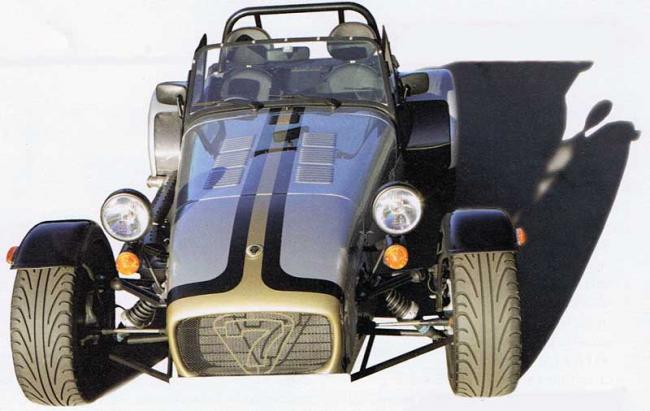
Like the 6, it was sold as a part completed kit, which included many of the specialist parts needed and with a choice of engine, gearbox and axles.
The Series One, built between engine (28bhp), the Coventry Climax fire pump engine (75bhp), which had proved such a success on the race track, and the BMC "A' series engine (37bhp) from the Austin A30.
With tuning parts for both the Ford and BMC engines readily available, it was not difficult to boost power from either of the cheaper engine options.
Since the car weighed about 500kg, performance was fairly brisk by the standards of the late 50s.
Performance and handling were everything and the car was designed with a low centre of gravity and near 50/50 weight distribution.
The Lotus-modified handling without resorting to expensive parts. Ride quality was secondary with little cushioning from the tiny flat bench seat.
Series Two followed between 1960 and 1968 with a choice of BMC A or a greater variety of Ford engines.
Then came Ford and Lotus twin-cam (Ford-based) power for the Series Three (1968 – 1970) and the Series Four (1970 - 1973) boosted the top power rating to 115bhp.
Lotus sold the rights to the 7 to Caterham Cars in 1973 and Caterham has continued wide range of power outputs — up to around 300bhp
APRIL 2007 MOTOR INDUSTRY MAGAZINE 31
Derived from the Lotus 6, the first Lotus production car launched five years earlier, the 7 refined the formula for a lightweight two-seater sports car designed for road and track use, based around a multi-tubular space-frame.
On this light and strong framework the original 7 was clothed in aluminium panels.

Like the 6, it was sold as a part completed kit, which included many of the specialist parts needed and with a choice of engine, gearbox and axles.
The Series One, built between engine (28bhp), the Coventry Climax fire pump engine (75bhp), which had proved such a success on the race track, and the BMC "A' series engine (37bhp) from the Austin A30.
With tuning parts for both the Ford and BMC engines readily available, it was not difficult to boost power from either of the cheaper engine options.
Since the car weighed about 500kg, performance was fairly brisk by the standards of the late 50s.
Performance and handling were everything and the car was designed with a low centre of gravity and near 50/50 weight distribution.
The Lotus-modified handling without resorting to expensive parts. Ride quality was secondary with little cushioning from the tiny flat bench seat.
Series Two followed between 1960 and 1968 with a choice of BMC A or a greater variety of Ford engines.
Then came Ford and Lotus twin-cam (Ford-based) power for the Series Three (1968 – 1970) and the Series Four (1970 - 1973) boosted the top power rating to 115bhp.
Lotus sold the rights to the 7 to Caterham Cars in 1973 and Caterham has continued wide range of power outputs — up to around 300bhp
APRIL 2007 MOTOR INDUSTRY MAGAZINE 31

