Lotus 2.2 Lt. Chargecooled Engine
by Simon P. Wood and John H. Bloomfield Lotus Engineering
Reprinted with permission © 1990 SAE Inc.
6.0 ACHIEVEMENTS
It is intended to discuss achievements in three distinct sections: 6.1 Engine Performance
6.2 Emission Performance
6.3 Vehicle Performance
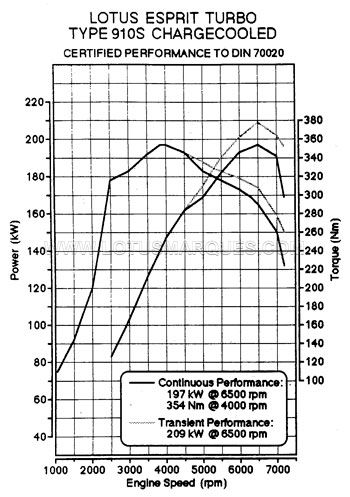
6.1 ENGINE PERFORMANCE - The certified performance, to DIN70020, of 197 kw (264 bhp) is, to our knowledge, both the highest performance four-cylinder engine and the highest specific performance output of any engine meeting Federal and European emission legislation. Peak torque is achieved at the relatively low speed of 4000 rpm, with power peaking 900 rpm before maximum engine rpm at 6500 rpm.
Obviously these outputs result in considerable mechanical and thermal loadings. The peak cylinder pressure is typically in the range of 90-100 bar and cyclic irregularity is well controlled. This is demonstrated in the waterfall plot showing 20 consecutive cylinder events. The high pressure is achieved without severe rates of pressure rise, as may be seen from the pressure diagram, and mass fraction burnt curve. Peak pressure is recorded at 16-18° after TDC and 90% mass burnt by 20° ATDC.
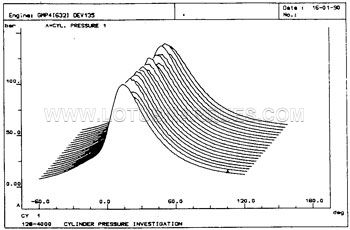
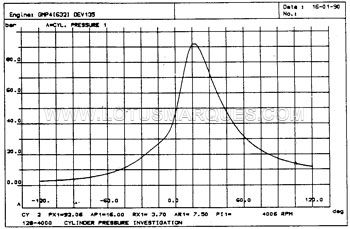
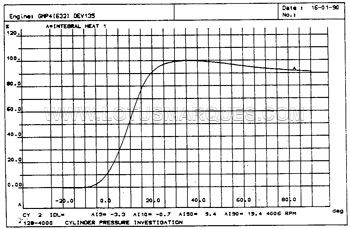
Above data measured at 4000 rpm, full load.
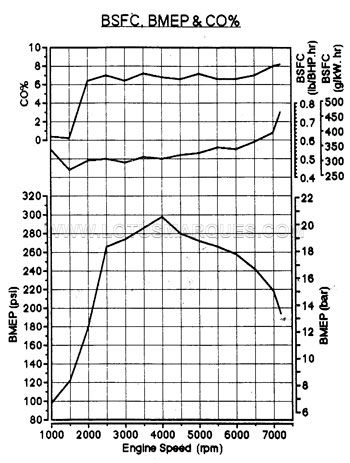
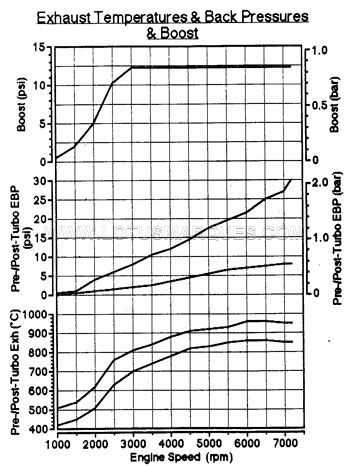
BMEP peaks at 20.6 bar (4000 rpm), where a BSFC of 300 gm/kw hr is recorded. At higher engine speeds a gradually increasing richer mixture is used to control exhaust gas temperature to a peak of 980° C. This can be seen by the change in slope of the exhaust temperature curves, and the consequential increase in BSFC.
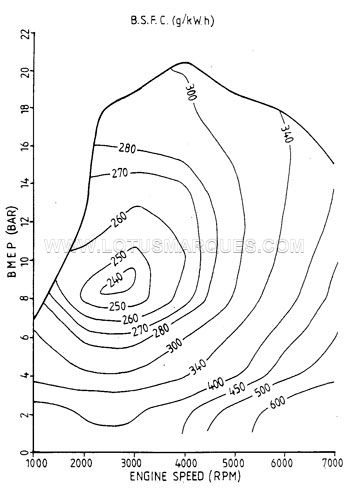
At part load conditions a minimum BSFC of 240 gm/kw hr is achieved through careful turbine and compressor matching whilst still running the over rich stoichiometric air/fuel ratio, currently necessary for feedback control systems, at which absolute minimum BSFCs cannot be obtained.
It must be remembered when comparing this figure with other engines that the geometric compression ratio is 8.0:1, and that it has been achieved with a valve overlap of 42 degrees.
6.2 EMISSION PERFORMANCE - As previously stated, the required emission legislation for Federal and European markets is now very similar for the greater than 2.0 It class vehicles. The targets during the development were therefore set a level which would ensure achievement of Federal (49 states and CARB) and European certification, with a common engine management calibration. The table shows the actual achieved results.
HC CO NOx
Federal Legislation .41 3.4 .4
With DFs .31 2.8 .36
Development Target .2 2.0 .2
Certification level .14 1.0 .27
(Figures in gm/mile)
To confirm compliance of production vehicles a policy of audit monitoring, following 100% sampling of the first 50 vehicles has been adopted. The audit frequency of 10% is comparatively high, based in a total production volume of 550 vehicles in 1989.
Results from these audit tests are displayed in the form of histograms. Each shows the comparison of the early production 100% sample rate (recorded in mid 1988), and the results from the latest audit tests recorded over one year later. Tabulation of the results for comparison gives:
HC CO NOx
Targets with DFs .31 2.8 .36
Mean 100% sample .14 1.5 .12
Mean audit sample .17 1.9 .16
3 6 100% sample .29 2.7 .31
3 6 audit sample .26 2.8 .34
(Figures in gm/mile)
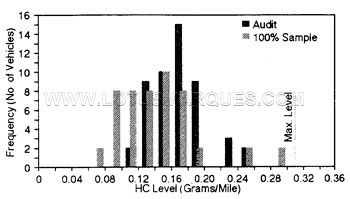
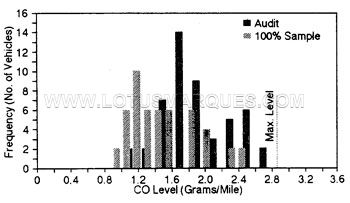
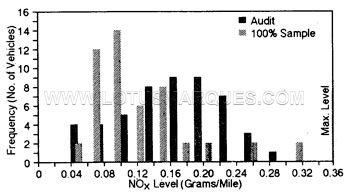
The results show that the mean-gaseous emission levels are well under control, and compare favourably with the certification levels. It is thought that the lower NOx, for production engines, is because these engines have no carbon build up and therefore are not stabilised. The higher levels of CO could be due to similar reasons and new tyre losses. The 36 level indicates the estimated capability of the quality control system. It represents the limits within which 99.8% of all values can be expected to be recorded, based upon the distribution of previous results. In this instance it may be seen that the CO concentration falls close to the maximum allowed levels with deterioration factors taken into account although this is still within the 3a level.
This is a highly acceptable result for vehicles needing to comply with European 88/76 and Federal 50 state requirements. These statistical capability levels have proved to be of immense use in setting, and monitoring production control systems.
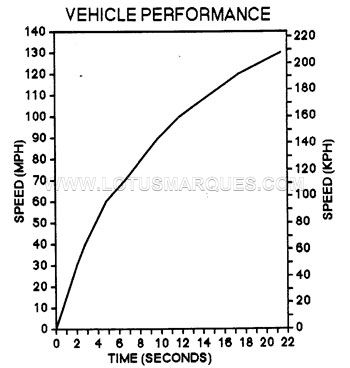
6.3 VEHICLE PERFORMANCE - Finally it is obviously the complete vehicle performance which is important. Running on regular 95 RON unleaded fuel typical performance figures are:
0- 60 mph 4.7 seconds
0-100 mph 11.9 seconds
Maximum speed 163 mph (262 kph)
Gear performance and engine response is even more impressive, as an example:
Fourth Gear: 50 - 70 mph 3.8 seconds
70 - 90 mph 4.0 seconds
Fifth Gear: 70 - 90 mph 5.3 seconds
90- 110 mph 6.1 seconds
These levels of performance place the vehicle among the top of the "supercar"class of vehicle although few meet such stringent exhaust and environmental controls.
The engine drives through a five speed transaxle to Goodyear Eagle 245/50 ZR 16 rear tyres. Gear ratios are:
Gear Ratio Mph/1000 rpm
5th 0.82:1 23.1
4th 1.03:1 18.4
3rd 1.38:1 13.7
2nd 2.05:1 9.3
1st 3.36:1 5.6
Final Drive 3.889:1
Kerb Weight 1305 kg
7 SUMMARY
Lotus set out to develop and produce an exceptionally high performance engine complying with worldwide legislation. This has been achieved in a light weight and highly efficient power unit, the main features of which have already been described in detail and include:
Forged Aluminium Liners
Optimised Combustion Chambers
Chargecooling
Catalyst Design
Exhaust Back Pressure
Valve Engine Management System
Quality Control Systems
In conclusion, this project clearly signals the rebirth of higher engine efficiencies in harmony with the environment and gives real world credence to the Lotus motto of "The Power of Innovation".
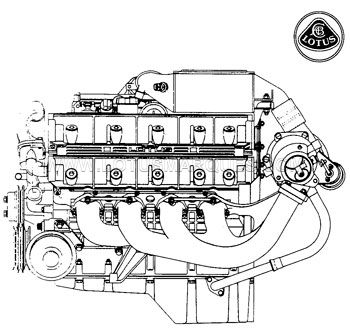
8 APPENDIX
Engine Specification
* Four-cylinders in line
* Displacement - 2174 cc
* Bore x stroke - 95.3 - 76.2
* Four valves per cylinder (two intake, two exhaust)
* Dual cam shafts
* Direct acting mechanical inverted bucket tappets
* Toothed belt timing drive
* Aluminium cylinder head, block, bearing ladder, frame and sump
* Open deck cylinder block
* Deep seated aluminium liners with "Nikasil" coated bores
* Cast SG iron crankshaft
* Forged steel connecting rods
* Forged aluminium pistons
* Semi-sequential fuel injection system
* Garratt TBO3 turbocharger
* Weight 180 kg complete with ancillaries and clutch
9 ACKNOWLEDGMENTS
The authors would like to thank the following organisations_ for their assistance and enthusiasm in supporting this project:
Johnson Matthey, TI Cheswick, NGK AC Rochester/Delco Electronics AES/GM Tech Centre
Behr, Mahle
Note:
Simon P. Wood is now Vice Technical Director for Bugatti
by Simon P. Wood and John H. Bloomfield Lotus Engineering
Reprinted with permission © 1990 SAE Inc.
6.0 ACHIEVEMENTS
It is intended to discuss achievements in three distinct sections: 6.1 Engine Performance
6.2 Emission Performance
6.3 Vehicle Performance
6.1 ENGINE PERFORMANCE - The certified performance, to DIN70020, of 197 kw (264 bhp) is, to our knowledge, both the highest performance four-cylinder engine and the highest specific performance output of any engine meeting Federal and European emission legislation. Peak torque is achieved at the relatively low speed of 4000 rpm, with power peaking 900 rpm before maximum engine rpm at 6500 rpm.
Obviously these outputs result in considerable mechanical and thermal loadings. The peak cylinder pressure is typically in the range of 90-100 bar and cyclic irregularity is well controlled. This is demonstrated in the waterfall plot showing 20 consecutive cylinder events. The high pressure is achieved without severe rates of pressure rise, as may be seen from the pressure diagram, and mass fraction burnt curve. Peak pressure is recorded at 16-18° after TDC and 90% mass burnt by 20° ATDC.
Above data measured at 4000 rpm, full load.
BMEP peaks at 20.6 bar (4000 rpm), where a BSFC of 300 gm/kw hr is recorded. At higher engine speeds a gradually increasing richer mixture is used to control exhaust gas temperature to a peak of 980° C. This can be seen by the change in slope of the exhaust temperature curves, and the consequential increase in BSFC.
At part load conditions a minimum BSFC of 240 gm/kw hr is achieved through careful turbine and compressor matching whilst still running the over rich stoichiometric air/fuel ratio, currently necessary for feedback control systems, at which absolute minimum BSFCs cannot be obtained.
It must be remembered when comparing this figure with other engines that the geometric compression ratio is 8.0:1, and that it has been achieved with a valve overlap of 42 degrees.
6.2 EMISSION PERFORMANCE - As previously stated, the required emission legislation for Federal and European markets is now very similar for the greater than 2.0 It class vehicles. The targets during the development were therefore set a level which would ensure achievement of Federal (49 states and CARB) and European certification, with a common engine management calibration. The table shows the actual achieved results.
HC CO NOx
Federal Legislation .41 3.4 .4
With DFs .31 2.8 .36
Development Target .2 2.0 .2
Certification level .14 1.0 .27
(Figures in gm/mile)
To confirm compliance of production vehicles a policy of audit monitoring, following 100% sampling of the first 50 vehicles has been adopted. The audit frequency of 10% is comparatively high, based in a total production volume of 550 vehicles in 1989.
Results from these audit tests are displayed in the form of histograms. Each shows the comparison of the early production 100% sample rate (recorded in mid 1988), and the results from the latest audit tests recorded over one year later. Tabulation of the results for comparison gives:
HC CO NOx
Targets with DFs .31 2.8 .36
Mean 100% sample .14 1.5 .12
Mean audit sample .17 1.9 .16
3 6 100% sample .29 2.7 .31
3 6 audit sample .26 2.8 .34
(Figures in gm/mile)
The results show that the mean-gaseous emission levels are well under control, and compare favourably with the certification levels. It is thought that the lower NOx, for production engines, is because these engines have no carbon build up and therefore are not stabilised. The higher levels of CO could be due to similar reasons and new tyre losses. The 36 level indicates the estimated capability of the quality control system. It represents the limits within which 99.8% of all values can be expected to be recorded, based upon the distribution of previous results. In this instance it may be seen that the CO concentration falls close to the maximum allowed levels with deterioration factors taken into account although this is still within the 3a level.
This is a highly acceptable result for vehicles needing to comply with European 88/76 and Federal 50 state requirements. These statistical capability levels have proved to be of immense use in setting, and monitoring production control systems.
6.3 VEHICLE PERFORMANCE - Finally it is obviously the complete vehicle performance which is important. Running on regular 95 RON unleaded fuel typical performance figures are:
0- 60 mph 4.7 seconds
0-100 mph 11.9 seconds
Maximum speed 163 mph (262 kph)
Gear performance and engine response is even more impressive, as an example:
Fourth Gear: 50 - 70 mph 3.8 seconds
70 - 90 mph 4.0 seconds
Fifth Gear: 70 - 90 mph 5.3 seconds
90- 110 mph 6.1 seconds
These levels of performance place the vehicle among the top of the "supercar"class of vehicle although few meet such stringent exhaust and environmental controls.
The engine drives through a five speed transaxle to Goodyear Eagle 245/50 ZR 16 rear tyres. Gear ratios are:
Gear Ratio Mph/1000 rpm
5th 0.82:1 23.1
4th 1.03:1 18.4
3rd 1.38:1 13.7
2nd 2.05:1 9.3
1st 3.36:1 5.6
Final Drive 3.889:1
Kerb Weight 1305 kg
7 SUMMARY
Lotus set out to develop and produce an exceptionally high performance engine complying with worldwide legislation. This has been achieved in a light weight and highly efficient power unit, the main features of which have already been described in detail and include:
Forged Aluminium Liners
Optimised Combustion Chambers
Chargecooling
Catalyst Design
Exhaust Back Pressure
Valve Engine Management System
Quality Control Systems
In conclusion, this project clearly signals the rebirth of higher engine efficiencies in harmony with the environment and gives real world credence to the Lotus motto of "The Power of Innovation".
8 APPENDIX
Engine Specification
* Four-cylinders in line
* Displacement - 2174 cc
* Bore x stroke - 95.3 - 76.2
* Four valves per cylinder (two intake, two exhaust)
* Dual cam shafts
* Direct acting mechanical inverted bucket tappets
* Toothed belt timing drive
* Aluminium cylinder head, block, bearing ladder, frame and sump
* Open deck cylinder block
* Deep seated aluminium liners with "Nikasil" coated bores
* Cast SG iron crankshaft
* Forged steel connecting rods
* Forged aluminium pistons
* Semi-sequential fuel injection system
* Garratt TBO3 turbocharger
* Weight 180 kg complete with ancillaries and clutch
9 ACKNOWLEDGMENTS
The authors would like to thank the following organisations_ for their assistance and enthusiasm in supporting this project:
Johnson Matthey, TI Cheswick, NGK AC Rochester/Delco Electronics AES/GM Tech Centre
Behr, Mahle
Note:
Simon P. Wood is now Vice Technical Director for Bugatti