Dispelling the myth
One of the most talked about components on the Ford/Lotus twin cam engine is probably the water pump and front timing cover.
This important component is often subject to poor maintenance and substandard engineering practice.
Too often the pump is cited as being unreliable but if built correctly and the drive belt tensioned correctly, will last five to seven years under normal driving conditions.
The stories of failures surrounding the water pump can often be directly attributed to poor assembly techniques or the engine being neglected.
The pump
The origins of the internal components such as the impellor, seal and bearing can be traced back to the Ford 105E Anglia and early Cortina.
The water pump is an integral part of the timing cover and therefore cannot be removed as a separate item to be easily overhauled.
The Lotus workshop manual states that the cylinder head should be removed prior to the removal of the timing cover.
This is the ideal procedure to ensure an oil-tight engine but is time consuming and therefore expensive.
However, it is possible to remove the timing cover and pump assembly whilst the cylinder head still in situ.
This first requires the sump to be removed and may cause problems for Elan and Escort owners who have a fixed cross-member under the sump pan.
Limited sump access on these vehicles has brought about a simple modification of installing a removable cross-member.
The timing cover
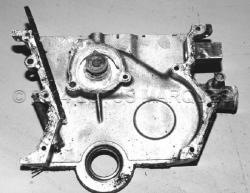
There are two types of timing cover fitted to the Lotus twin cam engine.
The early type is die cast and can be easily recognised by the timing marks, twenty degrees only.
The later type is traditional sand cast and has a thirty degree timing mark and can still be obtained from Lotus (part number A026E0705S)
The timing cover also contains the timing chain tensioner mechanism and timing chain damper pad.
Note: A new timing chest from Lotus is supplied fully machined but is not fitted with a dipstick tube.
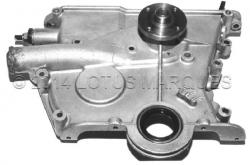 Early type die cast timing chest cover
Generator/alternator mounting plate
To prevent damage to the timing cover caused by the alternator/dynamo adjusting strap bolt, fit triangular mounting plate (part number 050E6004) as described in Section M on page 95 of the Lotus Elan Plus 2 workshop manual.
The mounting strap is standard equipment as fitted to the Lotus Elan Plus 2S 130.
This plate should be secured to the rear side and the three upper most bolt holes on the timing cover.
This simple modification spreads the load of the centre strap bolt.
This cures a frequently observed problem of the casting breaking and oil leaking around the offending bolt hole.
This mounting plate is a worth while modification that can be easily carried out to any twin cam engine installed in a single seater race car, Lotus 7, Elan, Elan Plus 2, etc.
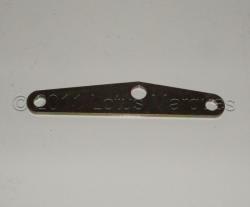 Generator/alternator mounting plate
The above mounting plate is yet another quality component that can be purchased from Lotus Marques.
The back plate
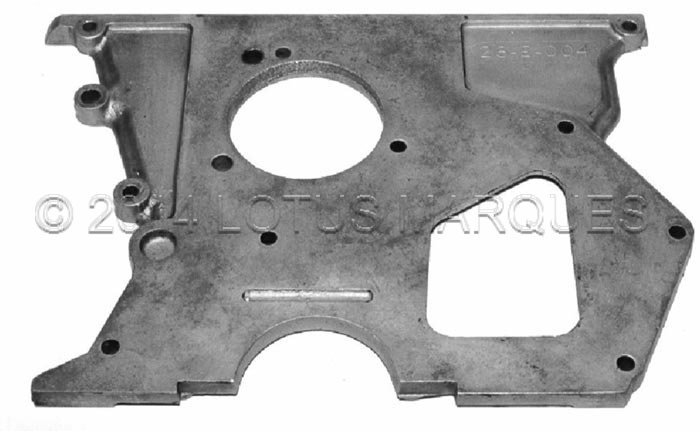
This component is manufactured from aluminium alloy using a traditional sand cast method.
It is located between the front timing cover and the cylinder block.
Its function is to mount the timing cover and water pump to the front of the cylinder block.
This is initially located to the cylinder block by a single bolt located in the middle of the plate.
The plate should be installed on the cylinder block using a paper gasket (Lotus part number A026E0005Z) and the correct sealant, which is Wellseal.
Note, there is NO gasket located between the back plate and the timing cover housing.
Use only sealant Loctite 587 between the back-plate and timing cover to ensure an oil tight engine.
Before installing the back-plate on the cylinder block, make sure the small oil gallery (1.5mm hole) that feeds the crankshaft sprocket is clear.
Also check the condition of the water pump bypass hole.
Make sure this is not badly corroded, as this can be a source of water leaking into the sump.
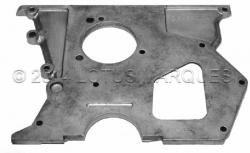
The water pump spacer
This component provides a water passage from the pump housing, through the timing chain enclosure to the front of the cylinder block.
At the back of the spacer is a locating lug, which engages in a slot in the front cover.
The spacer also has two grooves machined in the external circumference in which two Nitrile ‘O’ rings are located.
The spacer and the ‘O’ ring seals prevent water entering the sump and oil from entering the cooling system.
Unfortunately, the genuine spacer supplied by Lotus is cast aluminium alloy construction, which has a high zinc content and has poor corrosion resistance
Any pit marks or corrosion on the impellor face of the spacer will dramatically reduce the pump efficiency and therefore should be discarded.
Dismantling the water pump
Assuming the timing cover and water pump assembly have been removed from the cylinder block, the following steps should be followed.
If an attempt is made to dismantle the pump in any other sequence, then damage will occur to the casting and relevant components.
 Broken impellor caused by incorrect dismantling
Remove the timing chain tensioner housing complete with thread, sealing washer, spring and piston.
Unbolt the four 1/4” UNC retaining bolts holding the pulley to the pump drive flange.
With a small 3 leg hub puller, carefully remove the flange from the bearing shaft.
With some thin nose pliers, remove the bearing wire clip from its groove located inside the inspection hole.
Next, place the timing cover in a bucket of boiling hot water for two minutes. (Basic physics apply here)
Applying heat this way allows the aluminium casting to expand and assists in releasing the captive bearing.
The bearing can now be pressed out using a hydraulic press and a suitable mandrel.
The timing cover should be supported underneath and be square to the hydraulic ram to avoid any damage.
The mandrel should only press on the outer casing of the bearing and not foul the housing.
The bearing will gradually emerge complete with impellor, slinger and mechanical seal.
The spacer can now be carefully removed complete with sealing ‘O’ rings.
All the reusable parts should be scrupulously cleaned and inspected for corrosion.
Copyright © 2014 Lotus Marques
One of the most talked about components on the Ford/Lotus twin cam engine is probably the water pump and front timing cover.
This important component is often subject to poor maintenance and substandard engineering practice.
Too often the pump is cited as being unreliable but if built correctly and the drive belt tensioned correctly, will last five to seven years under normal driving conditions.
The stories of failures surrounding the water pump can often be directly attributed to poor assembly techniques or the engine being neglected.
The pump
The origins of the internal components such as the impellor, seal and bearing can be traced back to the Ford 105E Anglia and early Cortina.
The water pump is an integral part of the timing cover and therefore cannot be removed as a separate item to be easily overhauled.
The Lotus workshop manual states that the cylinder head should be removed prior to the removal of the timing cover.
This is the ideal procedure to ensure an oil-tight engine but is time consuming and therefore expensive.
However, it is possible to remove the timing cover and pump assembly whilst the cylinder head still in situ.
This first requires the sump to be removed and may cause problems for Elan and Escort owners who have a fixed cross-member under the sump pan.
Limited sump access on these vehicles has brought about a simple modification of installing a removable cross-member.
The timing cover
There are two types of timing cover fitted to the Lotus twin cam engine.
The early type is die cast and can be easily recognised by the timing marks, twenty degrees only.
The later type is traditional sand cast and has a thirty degree timing mark and can still be obtained from Lotus (part number A026E0705S)
The timing cover also contains the timing chain tensioner mechanism and timing chain damper pad.
Note: A new timing chest from Lotus is supplied fully machined but is not fitted with a dipstick tube.
 Early type die cast timing chest cover
Generator/alternator mounting plate
To prevent damage to the timing cover caused by the alternator/dynamo adjusting strap bolt, fit triangular mounting plate (part number 050E6004) as described in Section M on page 95 of the Lotus Elan Plus 2 workshop manual.
The mounting strap is standard equipment as fitted to the Lotus Elan Plus 2S 130.
This plate should be secured to the rear side and the three upper most bolt holes on the timing cover.
This simple modification spreads the load of the centre strap bolt.
This cures a frequently observed problem of the casting breaking and oil leaking around the offending bolt hole.
This mounting plate is a worth while modification that can be easily carried out to any twin cam engine installed in a single seater race car, Lotus 7, Elan, Elan Plus 2, etc.
 Generator/alternator mounting plate
The above mounting plate is yet another quality component that can be purchased from Lotus Marques.
The back plate
This component is manufactured from aluminium alloy using a traditional sand cast method.
It is located between the front timing cover and the cylinder block.
Its function is to mount the timing cover and water pump to the front of the cylinder block.
This is initially located to the cylinder block by a single bolt located in the middle of the plate.
The plate should be installed on the cylinder block using a paper gasket (Lotus part number A026E0005Z) and the correct sealant, which is Wellseal.
Note, there is NO gasket located between the back plate and the timing cover housing.
Use only sealant Loctite 587 between the back-plate and timing cover to ensure an oil tight engine.
Before installing the back-plate on the cylinder block, make sure the small oil gallery (1.5mm hole) that feeds the crankshaft sprocket is clear.
Also check the condition of the water pump bypass hole.
Make sure this is not badly corroded, as this can be a source of water leaking into the sump.
The water pump spacer
This component provides a water passage from the pump housing, through the timing chain enclosure to the front of the cylinder block.
At the back of the spacer is a locating lug, which engages in a slot in the front cover.
The spacer also has two grooves machined in the external circumference in which two Nitrile ‘O’ rings are located.
The spacer and the ‘O’ ring seals prevent water entering the sump and oil from entering the cooling system.
Unfortunately, the genuine spacer supplied by Lotus is cast aluminium alloy construction, which has a high zinc content and has poor corrosion resistance
Any pit marks or corrosion on the impellor face of the spacer will dramatically reduce the pump efficiency and therefore should be discarded.
Dismantling the water pump
Assuming the timing cover and water pump assembly have been removed from the cylinder block, the following steps should be followed.
If an attempt is made to dismantle the pump in any other sequence, then damage will occur to the casting and relevant components.
 Broken impellor caused by incorrect dismantling
Remove the timing chain tensioner housing complete with thread, sealing washer, spring and piston.
Unbolt the four 1/4” UNC retaining bolts holding the pulley to the pump drive flange.
With a small 3 leg hub puller, carefully remove the flange from the bearing shaft.
With some thin nose pliers, remove the bearing wire clip from its groove located inside the inspection hole.
Next, place the timing cover in a bucket of boiling hot water for two minutes. (Basic physics apply here)
Applying heat this way allows the aluminium casting to expand and assists in releasing the captive bearing.
The bearing can now be pressed out using a hydraulic press and a suitable mandrel.
The timing cover should be supported underneath and be square to the hydraulic ram to avoid any damage.
The mandrel should only press on the outer casing of the bearing and not foul the housing.
The bearing will gradually emerge complete with impellor, slinger and mechanical seal.
The spacer can now be carefully removed complete with sealing ‘O’ rings.
All the reusable parts should be scrupulously cleaned and inspected for corrosion.
Copyright © 2014 Lotus Marques