QUESTION
I have a 1969 Lotus Elan +2 and the clutch engages over a very short portion of the pedal travel.
The worst of it is that the portion of the travel pedal is at the top of the throw -- after lots of "dead" travel.
So, initial launches are a challenge due to the abruptness of the engagement and the fact that you don't know when the abruptness is going to start given all the dead travel.
Do you have any advice on a fix?
B.C. - United Kingdom
ANSWER
It would be useful if you could provide some additional information if its a 4 speed Elan +2 or 5 speed conversion that you own and if the clutch has been changed recently.
Without this information I assume you have standard components and everything is in good condition.
The first items to check are the clutch master cylinder and slave cylinder bore sizes.
Master cylinder bore size should be 5/8" diameter.
Clutch slave cylinder bore size should be 7/8" diameter.
The next item to check is the clutch pedal return spring which is concealed inside the pedal box (item #9) on the exploded view below.
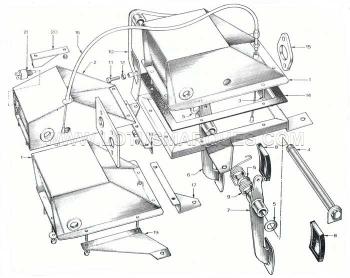
Make sure the dual spring is not broken as the pedal will not return fully to the top of its stroke.
Gently pull the clutch pedal backwards to check if the spring is broken (there should be minimal backward movement at the full return position).
Next check the clutch pedal stop bolt and lock nut (item # 11 and 12) are adjusted so the clutch is not over-driven.
It is quite common to see this nut and bolt missing or the pedal stop not adjusted correctly.
Next check the clutch installed height.
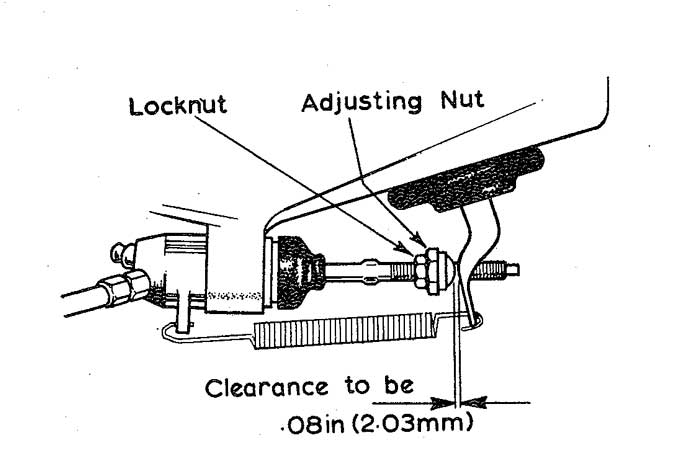
Assuming you have standard clutch components and they are in good condition, adjust the slave cylinder push-rod so there is 0.080" (2.00mm) clearance between the clutch fork and adjustment nut - please see the illustration below.

Once you have the correct clearance, check the clutch fork is at approximately 90 degrees to the gearbox input-shaft.
It is necessary to remove the rubber clutch lever gaiter and look into the bell-housing to do this.
At the same time it would be wise to check the clutch lever for any signs of cracks.
This will give you an indication if the clutch installed height is correct or the friction plate is significantly worn.
Once the friction plate is worn, the clutch pedal take up point will be at the top of the pedal stroke.
The clutch installed height is critical to its operation and associated components.
If the clutch lever is significantly off-set in either direction then further investigation is required (and the adjustment rod will not be set in the mid-position).
If you have the correct clutch, correct release bearing and all components are in good condition, and adjusted correctly then the bite-point should be close to the floor.
A question for you - Do you have an excessively heavy clutch pedal when its operated?
Copyright © 2013 Lotus Marques
I have a 1969 Lotus Elan +2 and the clutch engages over a very short portion of the pedal travel.
The worst of it is that the portion of the travel pedal is at the top of the throw -- after lots of "dead" travel.
So, initial launches are a challenge due to the abruptness of the engagement and the fact that you don't know when the abruptness is going to start given all the dead travel.
Do you have any advice on a fix?
B.C. - United Kingdom
ANSWER
It would be useful if you could provide some additional information if its a 4 speed Elan +2 or 5 speed conversion that you own and if the clutch has been changed recently.
Without this information I assume you have standard components and everything is in good condition.
The first items to check are the clutch master cylinder and slave cylinder bore sizes.
Master cylinder bore size should be 5/8" diameter.
Clutch slave cylinder bore size should be 7/8" diameter.
The next item to check is the clutch pedal return spring which is concealed inside the pedal box (item #9) on the exploded view below.

Make sure the dual spring is not broken as the pedal will not return fully to the top of its stroke.
Gently pull the clutch pedal backwards to check if the spring is broken (there should be minimal backward movement at the full return position).
Next check the clutch pedal stop bolt and lock nut (item # 11 and 12) are adjusted so the clutch is not over-driven.
It is quite common to see this nut and bolt missing or the pedal stop not adjusted correctly.
Next check the clutch installed height.
Assuming you have standard clutch components and they are in good condition, adjust the slave cylinder push-rod so there is 0.080" (2.00mm) clearance between the clutch fork and adjustment nut - please see the illustration below.
Once you have the correct clearance, check the clutch fork is at approximately 90 degrees to the gearbox input-shaft.
It is necessary to remove the rubber clutch lever gaiter and look into the bell-housing to do this.
At the same time it would be wise to check the clutch lever for any signs of cracks.
This will give you an indication if the clutch installed height is correct or the friction plate is significantly worn.
Once the friction plate is worn, the clutch pedal take up point will be at the top of the pedal stroke.
The clutch installed height is critical to its operation and associated components.
If the clutch lever is significantly off-set in either direction then further investigation is required (and the adjustment rod will not be set in the mid-position).
If you have the correct clutch, correct release bearing and all components are in good condition, and adjusted correctly then the bite-point should be close to the floor.
A question for you - Do you have an excessively heavy clutch pedal when its operated?
Copyright © 2013 Lotus Marques